


The conversation about digital sovereignty in Europe has become increasingly urgent. Between the CLOUD Act, unpredictable policy shifts and concrete examples of institutions being unilaterally cut off by Big Tech at the behest of the White House, organisations and governments are finally seeing the need for alternatives. Open source is repeatedly mentioned as the solution, and rightfully so.
But there’s a fundamental problem that barely anyone is addressing: the last mile.
The missing link in digital sovereignty
When organisations talk about migrating away from Google Workspace or Microsoft 365, they often focus on the technology itself. Can Proton replace Google Drive? Does OnlyOffice match Word and Excel? Is there a viable alternative to Microsoft Teams?
These are important questions, but they miss a crucial point: organisations don’t adopt software. They adopt solutions delivered by trusted partners.
Think about how Google Workspace and Microsoft 365 actually reach end users. It’s almost never through direct sales. Instead, there’s a massive ecosystem of resellers, integrators, and managed service providers who:
Understand the specific needs of their clients’ industries
Help with migration planning and execution
Provide training and change management
Offer ongoing support and optimisation
Build relationships based on years of collaboration
This infrastructure didn’t appear overnight. It took decades to build, and it’s incredibly effective. A school doesn’t wake up one day and decide to buy Google Workspace. They work with an education IT specialist who knows their budget constraints, their technical limitations, and their pedagogical requirements. A law firm doesn’t implement Microsoft 365 alone. They rely on a partner who understands legal compliance and document management workflows.
Why Open Source alone isn’t enough
The European digital sovereignty movement has produced impressive technologies. Projects like Matrix, Nextcloud, and La Suite Numérique demonstrate that open source can absolutely compete with (and in some cases exceed) what Big Tech offers.
A promising development is open source digital commons: collaboratively developed, publicly governed platforms that aren’t controlled by a single government or company. They can’t be weaponised or shut down by any single entity. This is fundamentally different from simply being open source. It’s about governance and strategic autonomy as much as code.
La Suite Numérique is a prime example. Developed through French-German-Dutch government collaboration, as part of the Digital Commons EDIC, it represents a new model for building digital infrastructure. But here's the challenge: it's being built primarily for the French public sector, not as a commercial product with a ready-made private sector supply chain.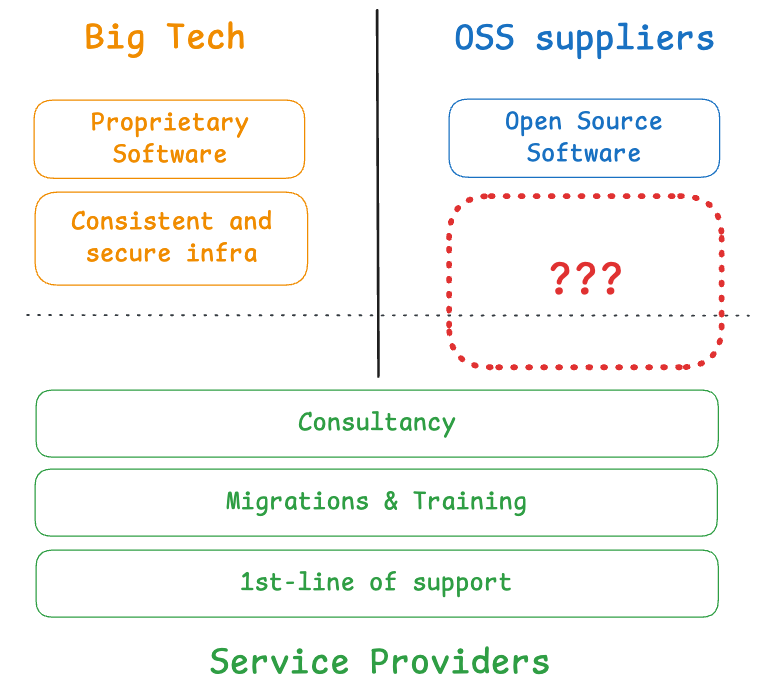
Consider the experience from both sides. An organisation that wants Microsoft 365 right now can fill in their credit card details and have their entire team collaborating within five minutes. When they go through a service provider instead, it’s not much harder: the MSP can provision a tenant through Microsoft’s partner portal in an afternoon.
Open Source alternatives offer neither path. There’s no self-service onboarding, and for service providers there’s no simple way to deploy and manage these solutions for their clients. This friction kills countless potential migrations.
Meanwhile, thousands of existing Google Workspace and Microsoft 365 partners are sitting on the sidelines. Many of them want to offer alternatives. They see their clients asking about sovereignty and data protection. They’re frustrated by Big Tech’s margin squeezing and increasingly restrictive partner programs. But they look at the open source landscape and see:
Complex deployment requirements
Ongoing maintenance burdens
Uncertainty about updates and security patches
Lack of clear commercial models
No clear path to offering these solutions profitably
So they stick with what they know, even as their margins shrink and their strategic autonomy diminishes.
This is the real bottleneck. Not the technology. Not even the willingness to change. It’s the practical infrastructure to deliver digital commons to end users in a way that’s economically viable for service providers and friction-free enough to compete with Big Tech’s instant gratification.
Bridging the gap
No organisation will flip a switch and move from Google Workspace to a completely sovereign stack overnight. The transition takes months, sometimes years, and requires hybrid setups, gradual user migration, and bespoke integrations with legacy systems.
Who’s best positioned to guide this? The existing service provider who already knows the organisation’s infrastructure, workflows, budget cycles, and culture. Not a new partner starting from scratch.
But right now, we’re asking these partners to take enormous risks: learn entirely new technologies, invest in infrastructure they may not fully understand, and potentially damage client relationships if things go wrong. What they actually need:
Technical simplicity: Deploy and manage sovereign solutions without becoming DevOps experts
Economic viability: Healthy margins that reward quality service, not volume
Reliability: Enterprise-grade uptime and support they can stand behind
Speed: Make it as easy to deliver digital commons as it is to deliver Big Tech’s status quo
Instead of slowly building a new partner network from zero, activate the thousands of existing relationships. Meet organisations where they are, with partners they already trust.
A path forward
At mosa.cloud, this is exactly what we’re building. We take La Suite Numérique, a comprehensive, open source digital commons, and make it deliverable by the existing service provider ecosystem.
We handle the technical complexity: deployment, maintenance, updates, security and scaling. Service providers focus on what they do best: understanding their clients and helping them adopt new tools successfully.
And we make sure the economics work. Fair margins. Predictable pricing. The ability to build a sustainable business around sovereign solutions. Both for service providers and OSS projects.
This isn’t just about technology or politics. It’s about creating a practical path for European organisations to reclaim their digital sovereignty. One where they don’t have to abandon their trusted advisors or navigate complex technical migrations alone.
This article is an introduction to the problem. In part 2 of this series, we’ll dive into the specific tools and approaches that make sovereign alternatives practical for service providers.
Are you a service provider ready to offer sovereign alternatives to your clients? Let’s get in touch!